
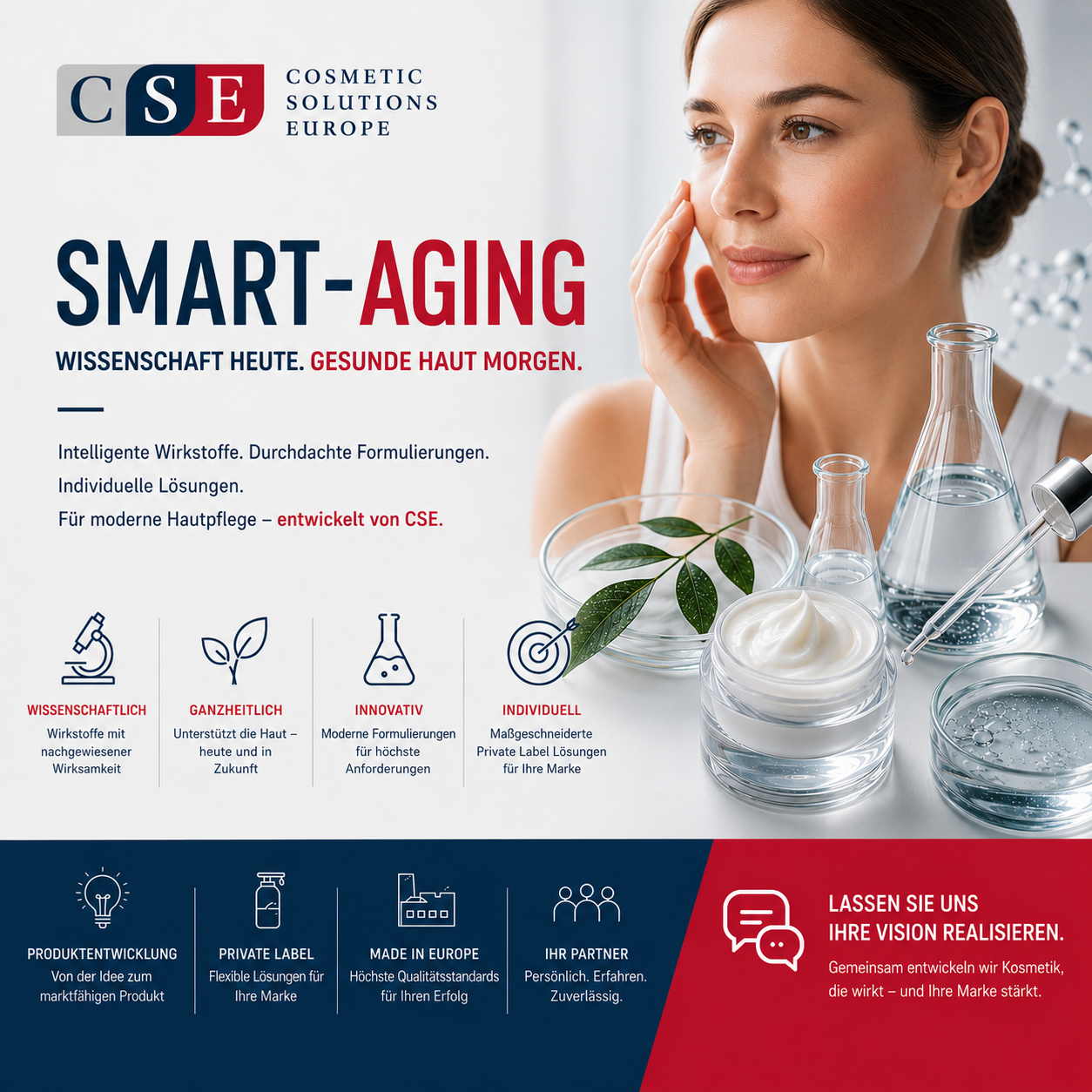
Why Smart Formulations Will Shape the Future of Skincare
The future of skincare is no longer solely about how to reduce the visible signs of aging. The focus is increasingly shifting toward a more comprehensive approach: smart aging.
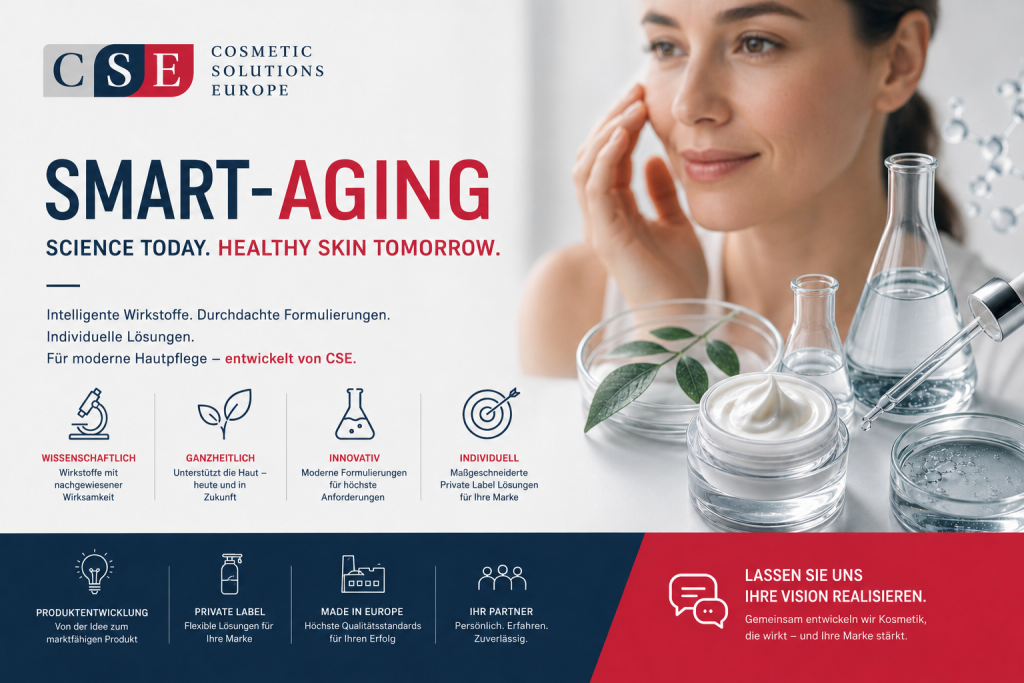
From Anti-Aging to Smart-Aging: A New Approach to Skincare
Rather than focusing solely on correcting the signs of aging, smart aging views the skin as a dynamic system. Modern formulations are designed to combine visible results with long-term skin health—for example, by supporting the skin barrier, providing antioxidant protection, delivering intense hydration, and specifically supporting the skin’s own natural processes.
For cosmetics brands and startups, this development opens up new opportunities: Products can be positioned not only based on individual trending active ingredients, but also on intelligent active ingredient systems with a verifiable scientific basis.
Why Smart Aging Is Becoming Relevant for Cosmetics Brands
Today, consumers are paying closer attention to the ingredients, effectiveness, and origin of cosmetic products. At the same time, traditional age boundaries are becoming less distinct.
Younger target groups take an interest in preventive skincare and barrier protection at an early stage. Mature target groups, on the other hand, expect visible results and high-performance active ingredient formulations.
Smart Aging combines both perspectives.
For brands, this creates an interesting positioning opportunity: skin wellness rather than the fight against aging.Especially in the private-label sector, this approach offers the chance to develop products that combine scientific innovation, modern brand communication, and long-term skin care.
Six Groups of Active Ingredients for Modern Smart-Aging Concepts
1. Peptides – Communication at the Skin Level
Peptides are among the most exciting active ingredients in modern skincare. Certain peptides used in cosmetics can support processes related to the extracellular matrix and, consequently, to collagen and elastin, among other things.
Peptides are particularly interesting for product development because different types of peptides can be specifically selected for various formulation strategies.
This makes them suitable, for example, for serums, creams, and concentrated skincare products in the premium segment.
2. Bakuchiol – a plant-based active ingredient with potential
Bakuchiol has become a much-discussed active ingredient in modern smart-aging cosmetics.
The ingredient derived from Psoralea corylifolia is often positioned as a plant-based alternative to traditional retinoid formulations. Research indicates, among other things, that it has antioxidant, anti-inflammatory, and extracellular matrix-related effects.
Bakuchiol is particularly interesting for brands that want to combine high-performance skincare with a modern, plant-based product narrative.
3. Ceramides & Squalane – Focus on the Skin Barrier
A healthy skin barrier is essential for resilient, well-hydrated skin.
Ceramides are natural components of the lipid structure of the stratum corneum. Squalane, on the other hand, is a versatile emollient that leaves the skin feeling pleasant.
In intelligently formulated products, both ingredients can be part of a skincare regimen designed to strengthen the skin's barrier.
This makes it clear: Smart aging isn't just about focusing on wrinkles. The skin's long-term function and resilience become beauty goals in and of themselves.
4. Hyaluronic Acid – Smart Hydration
Hyaluronic acid has long been an established active ingredient in cosmetics. Of particular interest for modern product development is the targeted selection of different molecular weights and hyaluronic acid derivatives.
This makes it possible to develop hydration strategies that address different aspects of cosmetic skincare.
When combined with other active ingredients, hyaluronic acid can also serve as an important foundation for comfortable, hydrating smart-aging products.
5. Vitamin C Derivatives – Antioxidants Taken to the Next Level
Vitamin C is one of the best-known antioxidants in skincare. Stable derivatives such as ascorbyl tetraisopalmitate are of particular interest for modern formulations.
At the same time, recent research is expanding our scientific understanding of vitamin C: In a human 3D epidermal model published in 2025, vitamin C promoted the proliferation of epidermal keratinocytes and, through DNA demethylation, influenced the expression of proliferation-related genes.
For product developers, this demonstrates how dynamically the scientific basis of established active ingredients continues to evolve.
6. Resveratrol – Antioxidant Protection
Resveratrol is a polyphenol found in grapes, among other sources, and is of interest for advanced skincare regimens due to its antioxidant properties.
In smart-aging formulations, for example, it can be combined with barrier-strengthening lipids or hydrating active ingredients.
The goal: not to focus on a single “hero ingredient,” but to develop a well-thought-out system of active ingredients.
The Decisive Factor: Synergies in Formulation
The future of high-performance cosmetics does not lie solely in selecting as many trendy active ingredients as possible.
The key factor is how these active ingredients are formulated together.
Concentration, solubility, stability, pH, packaging, sensory properties, and potential interactions must be taken into account as early as the product development stage.
This is exactly where a well-thought-out smart-aging formula differs from a product that simply offers a long list of popular ingredients.
Possible conceptual combinations include, for example:
- Peptides + Squalane: Skincare, Skin Feel, and Sophisticated Active Ingredient Formulation
- Bakuchiol + Hyaluronic Acid: Smart Aging Combined with Intensive Hydration
- Ceramides + Antioxidant Ingredients: Barrier Protection Meets Environmental Skin Care
- Vitamin C derivatives + hydrating ingredients: antioxidant skincare with a "glow" focus
However, the most appropriate combination always depends on the desired product profile and the specific formulation.
From an Idea to Your Own Smart-Aging Skincare Line
For young cosmetics brands, the challenge often lies not in the product idea—but in developing a stable, marketable formulation based on it.
As a partner for private label and cosmetics product development, CSE – Cosmetic Solution Europe supports brands and startups every step of the way, from the initial concept to the finished product.
This allows for the product concept, target audience, desired active ingredients, texture, positioning, and brand strategy to be considered together from an early stage.
This results in products that not only tap into a current beauty trend but also have a clear, well-defined concept.
Conclusion: Smart aging is more than just a new term
Smart Aging represents a fundamental shift in perspective in skin care.
The focus is not on age, but on the question:
How can modern cosmetic formulations care for the skin today while also supporting its long-term resilience?
For cosmetics brands and startups, this opens up an exciting arena for innovation—from peptide serums to barrier-strengthening creams to premium antioxidant formulations.
The key here does not lie in a single trend ingredient.
It lies in the clever phrasing.
