
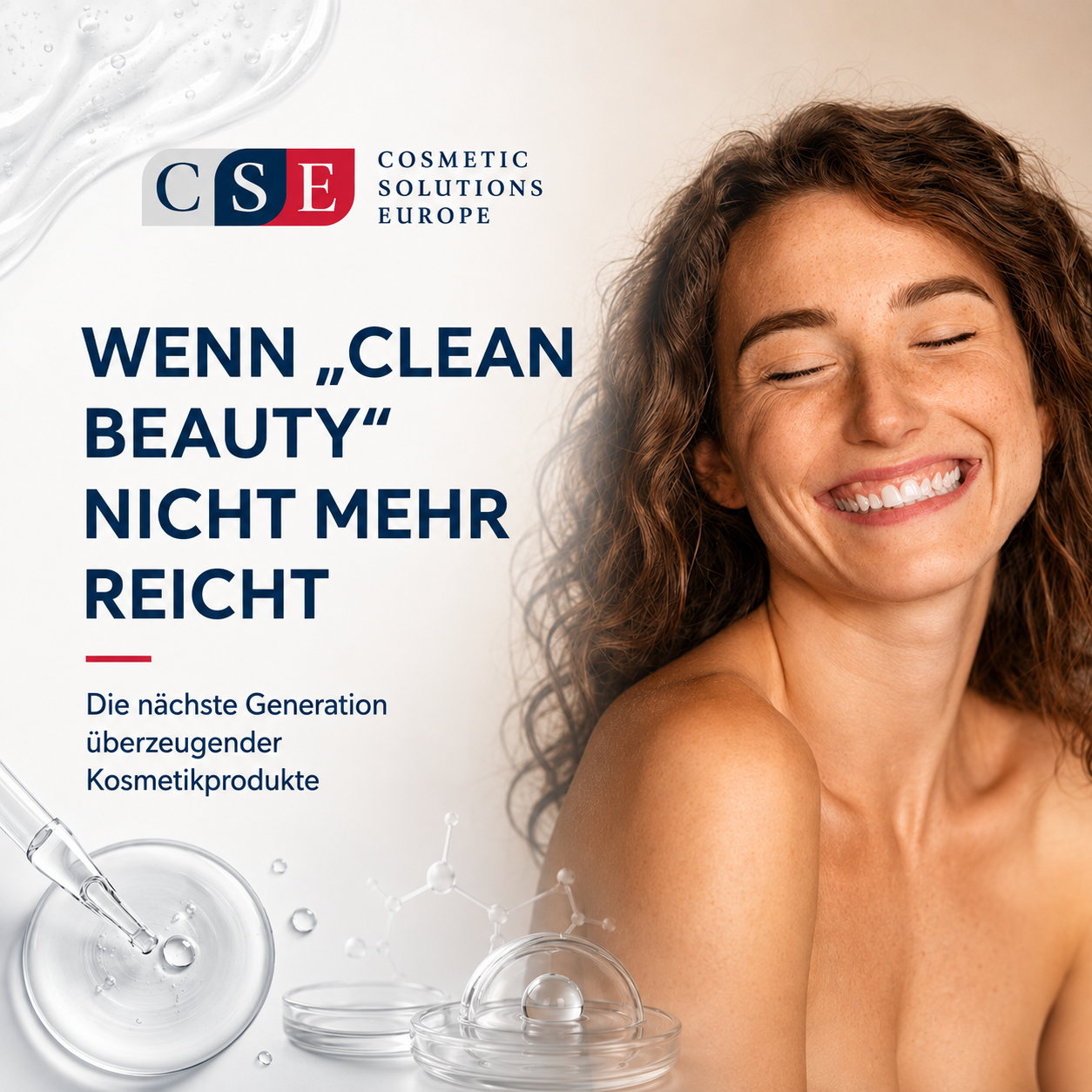
For a long time, “clean” was one of the beauty industry’s strongest promises. The term stood for carefully selected ingredients, simplified formulas, and a desire for greater transparency. In doing so, clean beauty struck a chord—and sparked important changes.
But the market has evolved. Today, consumers expect more than just a list of what a product does not contain. They ask: Does it work? Is it safe? Where do the raw materials come from? How verifiable are the claims? And how responsibly has the product been designed across its entire life cycle?
This doesn't mean that "clean beauty" is outdated. But "clean" alone is no longer enough to set a product apart.
"Clean" is not a uniform standard
What exactly does “clean beauty” mean? There’s no single, universally accepted answer. Depending on the brand, “clean” can refer to natural ingredients, vegan formulas, the exclusion of certain groups of substances, or a particularly short INCI list.
This openness has made the term popular—but it also makes it vague. This presents brands with a key challenge: They must clearly define their quality promise and provide verifiable evidence to support it. After all, trust isn’t built on a buzzword, but on transparency, consistency, and solid evidence.
Furthermore, “natural” does not automatically mean safer or more effective, just as synthetic ingredients are not inherently problematic. What matters most are the suitability of a raw material, its concentration in the product, the overall formulation, tolerability, and the scientific evaluation of the finished product.
From the Exclusion List to a Positive Product Promise
Many clean beauty concepts have been built around so-called “free-from” claims: free of parabens, silicones, mineral oils, or preservatives. But communication that focuses solely on what’s excluded has its limits. It can indiscriminately disparage approved ingredients, unintentionally create uncertainty, and often distracts attention from the product’s actual benefits.
The European claims framework already requires that cosmetic claims be, among other things, truthful, substantiated, fair, and understandable to consumers. Special requirements apply to “free-from” claims. For example, the absence of substances that are already prohibited by law may not be presented as a particular benefit. Claims that disparage approved ingredients or groups of ingredients must also be evaluated critically.
The more effective strategy, therefore, is not just to point out what’s missing—but to show what the product can do.
Instead of a long list of things to avoid, brands can, for example, focus on:
- what specific benefits the formulation offers for the skin,
- how this benefit was demonstrated,
- the target audience for which the product was developed,
- why certain raw materials were selected,
- how safety, stability, and tolerability are tested,
- and what measurable sustainability goals are being pursued.
This is how a generic “clean” becomes a credible, positive, and distinctive product profile.
The next generation of beauty is evidence-based
Modern cosmetics brands combine emotional brand experiences with technical substance. A trend in active ingredients alone does not make for a compelling product. What matters is whether the claimed effects can actually be substantiated for the finished formulation.
This applies to both traditional performance claims, such as “24-hour hydration,” and statements regarding the skin barrier, tolerability, or visible results. The more specific a claim is, the more appropriate and robust the evidence must be. Ingredient data can be valuable in this context, but it does not automatically replace evidence for the final product.
For successful product development, the formulation, testing strategy, and communication should therefore be considered together from the very beginning. Anyone who waits until shortly before launch to formulate claims risks not having sufficient evidence or the chosen claim not aligning with the available data.
Sustainability Requires Precision, Not Just Green Buzzwords
Sustainability communication is also becoming more specific. Broad terms such as “environmentally friendly,” “green,” or “climate-neutral” are coming under increasing regulatory and societal pressure. The EU Directive on Empowering Consumers for the Green Transition further tightens the requirements for environmental claims. The new regulations will take effect in member states on September 27, 2026.
For cosmetics brands, this means that environmental claims must be clear, specific, and verifiable. This applies not only to the formulation but also to packaging, the supply chain, production, and communication.
Concrete details—such as the percentage of recycled material in packaging, material savings, the origin of selected raw materials, or specific improvements in production—are more credible than a blanket promise of sustainability. It is important to disclose the frame of reference and not to make claims seem more significant than the underlying data allows.
Five Factors That Go Beyond Clean Beauty
1. Proven effectiveness
Product promises are defined as early as the development stage and supported by appropriate testing.
2. Regulatory-compliant claims
Every claim is evaluated in the context of the formulation, packaging, and communication environment—including implicit messages conveyed through images, seals, or product names.
3. Transparent Product Architecture
The selection of raw materials, the rationale behind the formulation, and the benefits for the target audience are transparent and present a consistent overall picture.
4. Measurable Sustainability
Specific data and clearly defined improvements are replacing vague green promises.
5. Quality Throughout the Entire Life Cycle
Stability, safety, reproducible manufacturing, appropriate packaging, and complete documentation are all taken into account from the very beginning.
Holistic development becomes a competitive advantage
When “Clean Beauty” is no longer enough, we don’t need a new buzzword. We need a better product concept.
For brands, the opportunity lies in integrating formulation, efficacy, sustainability, regulatory compliance, and brand positioning at an early stage. This is precisely where it is determined whether a product idea merely sounds trendy—or builds long-term trust.
Cosmetic Service supports cosmetics brands from the initial idea to a market-ready product: from research and formulation development, through the selection of raw materials and packaging materials, to quality assurance, regulatory support, GMP-compliant manufacturing, and logistics. This results in products whose claims not only sound good but are also well-thought-out, documented, and feasible.
Would you like to develop a cosmetic product that goes beyond "clean"? Talk to us about your product idea.
