
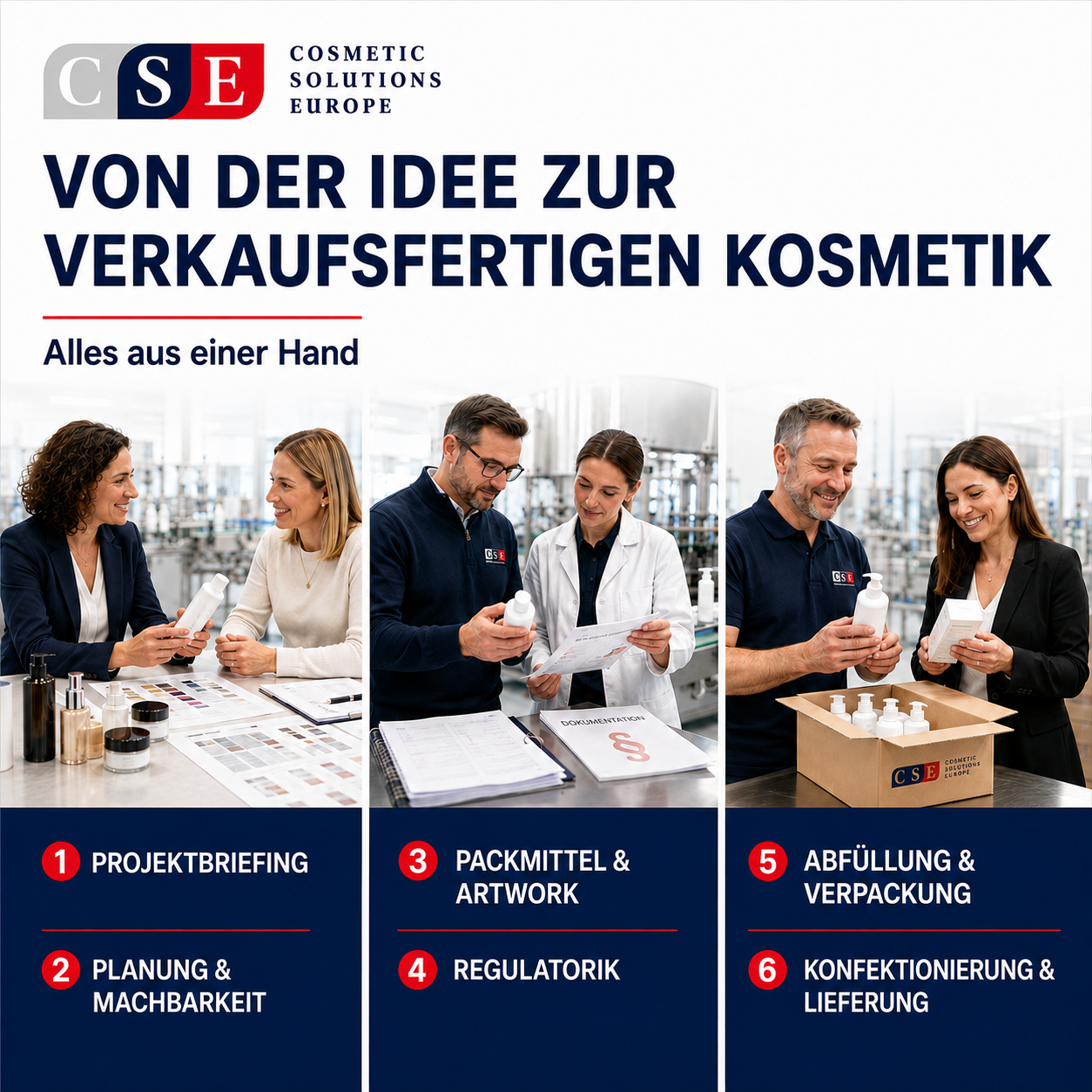
An approved formulation is a crucial milestone—but it is not yet a cosmetic product ready for sale. Only when the product, packaging materials, labeling, packaging process, quality, and logistics all come together can a product be created that is manufactured safely, delivered reliably, and presented effectively on the market.
This is exactly where professional contract filling for cosmetics comes in. It involves much more than simply filling a jar, tube, or bottle. Successful projects start with clear planning and the right question: Which filling and packaging solution is best suited to the product, the target volume, the distribution channel, and the brand image?
Contract bottling is a continuous process
In contract filling, an existing or supplied cosmetic product is filled into suitable retail or sample packaging. Depending on the project, additional services may be provided—such as the procurement of packaging materials, labeling, direct printing, secondary packaging, kitting, or preparation for shipment.
For cosmetics brands, working with a specialized partner offers several advantages:
- No dedicated bottling and packaging infrastructure is required.
- A variety of containers, closures, and formats can be implemented flexibly.
- Filling, packaging, and kitting can be controlled as a single process.
- Internal teams are relieved of some of the burden in production, coordination, and project management.
- Recurring series and increasing volumes can be prepared in a structured manner.
This is particularly relevant for brands with their own or already approved formulations, retail and product line projects, e-commerce brands, as well as sampling, promotional, and sachet projects.
The product and packaging must be technically compatible
Packaging is not just a design decision. The container must be suited to the product's characteristics, its intended use, the dosage, the protection required, and the planned logistics.
For example, a cream can be packaged in a jar, a tube, or an airless dispenser. Bottles, dispensers, or tubes are often used for lotions. Thin, liquid formulations require different filling and dispensing solutions than gels or highly viscous products. Sachets can be a suitable option for samples, promotional items, and product trials.
Before deciding on a packaging material, at least the following questions should therefore be addressed:
- Is the container suitable for the product's properties and intended use?
- Are the fill volume, closure, and dosage appropriate for the intended use?
- Are there sufficiently large labeling or printing areas available?
- Can mandatory labeling requirements and lot identification be implemented effectively?
- Are transportation, storage, and shipping taken into account?
If you wait too long to select the packaging material, you risk having to run additional test prints, make adjustments to the artwork, or face unnecessary delays.
Ensure Compatibility Between Products and Packaging Materials
Not every packaging material is automatically suitable for every cosmetic formulation. Therefore, product-packaging compatibility must be tested and documented before production begins. This involves evaluating, among other things, potential interactions, material stability, leak resistance, dispensing function, and protective properties. The packaging material is approved for use with the specific product only after it has successfully passed the suitability test.
Packaging combines function, brand impact, and cost-effectiveness
Packaging serves several purposes at once. It protects the product, facilitates easy removal, conveys the brand identity, and must be economically integrated into production and logistics.
However, it is not just the primary packaging that should be considered. The ready-to-sell unit may also include labels or direct printing, folding boxes, cellophane wrapping, duopacks, gift sets, and other packaging steps.
Priorities shift depending on the sales model:
- To create a high-quality brand image, the material, surface, texture, and print quality are all important.
- The closure and dispensing mechanism are key to ease of use.
- In e-commerce, the focus is on transport stability, package dimensions, and shipping feasibility.
- Small sample sizes and sachets are useful for sampling and market testing.
- For recurring series, standardized packaging materials and clearly defined set configurations are helpful.
Artwork and packaging should therefore never be designed in isolation. Fill volume, labeling, batch code, package dimensions, and packaging methods all influence one another.
A comprehensive briefing speeds up the feasibility study
The clearer the initial data is, the faster it is possible to assess feasibility, effort, and next steps. A robust project briefing should include, among other things, the following information:
- Product type, formulation status, and special product characteristics
- Desired fill quantity and target quantity
- potential follow-up volumes
- Intended container and closure system
- Labeling or Direct Printing
- Secondary Packaging and Scope of Packaging
- Desired delivery date
- Target Markets and Required Languages
- specific quality or documentation requirements
- Designated contacts and approval processes
When key information is missing, it often leads to follow-up questions and back-and-forth coordination. A structured briefing, on the other hand, establishes a common foundation for technical review, proposal development, and scheduling.
Quality begins before production starts
Filling and packaging must be integrated into a traceable quality process. Product specifications, intended packaging materials, approvals, and labeling should therefore be clearly agreed upon before production begins.
Examples of work packages related to quality include:
- matching the product to the packaging,
- defined approval points for the product, packaging, and artwork,
- Inspections during bottling and packaging,
- Batch labeling and traceable documentation,
- the coordination of relevant labeling and product information,
- as well as the structured handoff to the logistics department or the client.
A helpful readiness check includes the following questions: Have the product and packaging been approved? Are the fill quantity and target quantity clearly defined? Is the artwork final? Will all materials be available on time? And is it clear who makes the decision in case of deviations?
Seven Steps from the Project Briefing to Delivery
A typical project workflow can be divided into seven phases:
- Project Briefing: Clarify the product, formulation status, target quantity, packaging materials, fill quantity, and timeline.
- Feasibility and Planning: Classify the filling format, containers, labeling, and packaging from a technical perspective.
- Packaging Materials and Artwork: Coordinate closures, labels, print files, and required information.
- Samples and Approval: Document samples, specifications, and approval criteria.
- Filling and Packaging: Fill and package the product in accordance with defined process and quality requirements.
- Packaging: Create secondary packaging, sets, duo packs, or other sales units.
- Deployment and Scaling: Prepare goods for delivery and plan repeat orders or follow-up volumes.
It is important to work backward from the desired delivery date when creating the schedule. Packaging materials, print files, material availability, approvals, and packaging determine the overall schedule just as much as the actual filling process.
Common Mistakes—and How to Avoid Them
Many delays do not occur on the filling line, but rather during the preparation phase. Typical mistakes include:
The packaging material is selected too late.
The container, closure, and labeling area should be determined early on.
The artwork will be finalized before the technical details are worked out.
First, the packaging materials, the printing or labeling area, and the required information should be coordinated.
The briefing remains incomplete.
Product, fill volume, target volume, specifications, schedule, and logistics should all be included in a common project baseline.
The availability of materials is underestimated.
Packaging materials and printed components must be scheduled in a timely manner and provided in full.
Only the bottling process is considered.
Packaging, secondary packaging, storage, and shipping should be part of the planning process from the very beginning.
Scalability is not taken into account.
For successful products, follow-up volumes, replacement, and standardization should be taken into account early on.
Reduce Interfaces with a Full-Service Partner
CSE Cosmetic Solutions Europe supports cosmetic projects throughout the relevant production and packaging stages—from the professional filling of creams, lotions, gels, and liquids, through various packaging materials, to labeling, direct printing, secondary packaging, cellophane wrapping, gift sets, and duo packs.
Quality management, GMP production, regulatory affairs, product documentation, project management, and logistics round out our range of services. The close integration of these areas allows us to minimize interfaces and manage projects in a structured manner all the way through to the delivery of market-ready products.
Our white paper , “Contract Filling & Packaging for Cosmetics—From Concept to Ready-to-Sell Cosmetics,” brings together decision-making resources, checklists, and a practical briefing template for your next project.
Download the white paper: [LINK]
Or talk to us directly about your idea
The PPWR, effective August 12, 2026, is just the beginning:
In upcoming articles, we’ll outline the specific requirements that cosmetics companies should be following right now—from selecting packaging suitable for recycling and the use of recycled content to product-packaging compatibility and technical documentation.
Follow CSE Cosmetic Solutions Europe to stay up to date on regulatory developments, packaging trends, and practical solutions for your cosmetics projects.
