
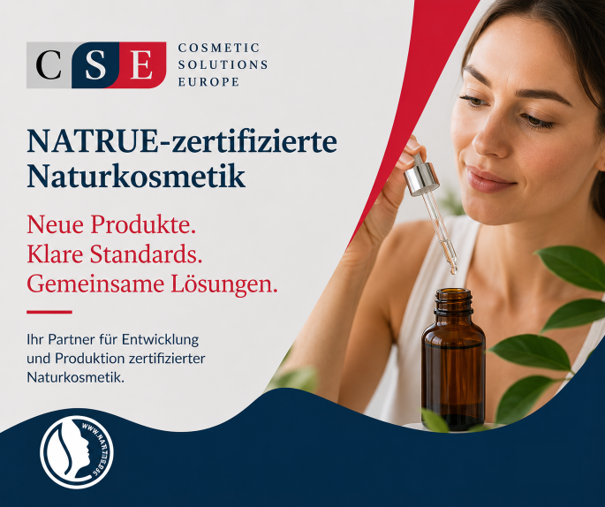
Anyone who carries a NATRUE-certified natural cosmetics brand has already made a clear choice: to adhere to defined standards, transparent product concepts, and high requirements for formulations and raw materials.
But a new challenge will arise no later than the next product line expansion.
How can a new natural cosmetics product be developed that aligns with the existing brand, functions reliably from a technical standpoint, and at the same time takes into account the requirements for the desired certification from the very beginning?
For brands, it’s not just the formulation that matters. Product development, raw materials, packaging, regulatory compliance, production, and certification requirements must all be considered together as early as possible.
NATRUE as a Standard for Natural and Organic Cosmetics
The NATRUE standard was developed specifically for natural and organic cosmetics and sets requirements for the composition of cosmetic products, the ingredients used, and permissible manufacturing processes.
For brands, this type of certification provides guidance and credibility.
For product development, this also means that not every technically feasible cosmetic formulation is automatically suitable for a certified natural cosmetic product.
Therefore, the requirements should not be checked only after the product is finished.
They should be included in the first product briefing.
Why Product Development That Can Be Certified Must Begin Early
A new cosmetic product is the result of many individual decisions.
What raw materials are used?
What functionality and sensor capabilities should the product have?
What preservation methods are available?
What kind of packaging works best for this recipe?
Which claims should be used later?
And what requirements does the desired certification entail?
Anyone who addresses these issues in isolation risks having to make adjustments later on.
That is why, especially when it comes to certified natural cosmetics, it makes sense to view product development as a holistic process.
New products must be consistent with the existing brand
For established natural cosmetics brands, it's not enough to simply develop any formula that can be certified.
A new product must fit into the existing brand universe.
This applies, for example, to:
- Ingredient Philosophy
- Scent and Sensory Perception
- existing product lines
- Target Audience
- Price Positioning
- Packaging
- Brand Communication
- Certification Strategy
A skincare product, a body care product, or a new serum doesn't just have to work technically.
It needs to feel like a natural part of the brand to existing customers.
Product Development for NATRUE-Compliant Brands
When developing a new natural cosmetics product, it is advisable to integrate several areas from the very beginning.
1. Product Concept and Positioning
The first step is to provide a briefing that is as specific as possible.
What product should we develop?
For which target audience?
What application and skin feel are desired?
What is the brand's approach to active ingredients?
What requirements arise from the current product line and the planned certification?
The more clearly these questions are answered, the more efficiently technical development can begin.
2. Raw Materials and Formulation
Selecting the right raw materials is one of the most important steps.
In addition to function, ingredients, availability, and price, certified natural cosmetics must also meet the specific requirements of the applicable standard.
This helps prevent a finished recipe from having to be fundamentally changed later on.
3. Pattern Development and Optimization
Even a good theoretical concept must prove itself in practice.
Samples are therefore used to evaluate, for example, consistency, spreadability, absorption, scent, and how the product feels on the skin.
Based on this, the formulation is optimized step by step.
4. Packaging
The formulation and packaging must be technically compatible.
For example, a product may have different requirements for an airless dispenser than for a tube or a jar.
In addition to the design, factors such as material, function, dosage, fillability, and product compatibility should therefore be evaluated early on.
5. Quality and Regulatory Affairs
In addition to certification requirements, each cosmetic product must comply with the regulatory requirements of its respective target market.
These include, among other things, documentation, safety assessments, labeling, and product information.
That is why regulatory affairs and product development should not be viewed separately from one another.
6. Production and Bottling
Once development and approvals are complete, the product is transferred to production.
The key point here is that a product must not only work as a laboratory prototype, but also be reproducible and capable of being manufactured in the planned quantities.
Why Choosing the Right Production Partner Is Crucial
For a natural cosmetics brand, launching a new product often involves coordinating with several partners:
Formulation development, raw material procurement, packaging, filling, regulatory documentation, and production.
The more interfaces there are, the greater the effort required for internal coordination.
This is exactly where a full-service approach can offer advantages.
CSE Cosmetic Solutions Europe supports B2B customers from the initial product concept and formulation development through packaging and production to regulatory compliance and delivery.
This allows key project components to be consolidated under a single point of contact.
CSE as a Development Partner for Certified Natural Cosmetics Brands
For established NATRUE brands, the current situation is particularly interesting.
The brand already exists.
The target audience is known.
A product philosophy and a concept of quality have been defined.
The focus now is on further developing the product line in a meaningful way.
In this regard, CSE can provide support in the following areas, for example:
- Development of New Natural Cosmetics Formulations
- Revision of Existing Product Concepts
- Selection of Suitable Raw Materials
- Pattern Development and Optimization
- Packaging Selection
- Production Planning
- Bottling
- Regulatory Affairs and Documentation
- Scaling New Product Lines
The certification process itself is carried out by the relevant independent certification bodies or those recognized by NATRUE.
The key advantage, therefore, does not lie in replacing the certification.
Rather, it lies in structuring a product project from the outset in such a way that the requirements of the desired standard can be taken into account early on.
Expanding the product line instead of offering a standard product
Especially for established brands, the key question should not be:
"Which ready-made standard recipe can we use?"
Rather:
"What product is missing from our brand—and how can we bring it to market professionally?"
This could be, for example, an addition to an existing skincare line, a new product type for a growing distribution channel, or an innovative formula for a new target audience.
CSE develops such projects in collaboration with the brand, from the initial concept to the finished product.
Are you planning to develop a new NATRUE-compliant natural cosmetics product?
Do you already carry certified natural cosmetics and want to expand your product line?
Or are you looking for a development and manufacturing partner that integrates formulation, packaging, manufacturing, and regulatory affairs into a structured process?
Then talk to CSE Cosmetic Solutions Europe about your next project.
Request information about the natural cosmetics project now.
There is also a white paper available for download
